A secure network architecture serves as your organization’s defense system, protecting your data, applications, and users from increasingly clever adversaries. A recent report found that 72% of business leaders faced increased cyber risks in 20241 – and yet, many of them still approve security budgets based on annual revenue, not asset exposure or threat surface. Security budgets should scale with architectural complexity, not income statements.
In this guide, we'll break down the essential components of network security and best practices for secure network design to help strengthen your organization's defenses in the evolving threat landscape.
What Is Network Security Architecture?
Network security architecture is the framework of policies, technologies, and controls that protect an organization's network infrastructure from cyber threats. When effectively designed, network security reduces threats like unauthorized access and malware from impacting your network or compromising your data.

Components of Network Security Architecture
Secure network architecture incorporates multiple defense layers to address threats at different entry points. Key components include:
Firewalls
Firewalls monitor and control all network traffic based on predefined security rules. They come in different forms, such as:
- Packet-filtering firewalls, which inspect data packets and block unauthorized access. Most ISP Routers can perform this function, but packet-filtering firewalls should be deprecated entirely in favor of connection-aware systems. Anything stateless belongs in a museum.
- Stateful inspection firewalls, which track active connections to determine whether traffic is legitimate. For cloud hosting providers, ISPs, or UCaaS/VoIP providers, these are used primarily to protect web or API services and ensure that functions provided to customers continue to operate.
- Host Based Firewalls. These are built into the operating systems of servers, such as Linux VMs, and help defend the internals of a service provider network. These should be configured in automated deployment (CI/CD) pipelines, not by hand. Manual iptables rules are a legacy practice that belongs to the 2000s.
- Next-generation firewalls (NGFWs), which integrate features like intrusion prevention, application awareness, and advanced threat intelligence. These are used primarily in the IT division of service providers and enterprises to protect internal users against attacks.
These options enable enterprises to select the protection levels needed for their specific network complexity. But beware of a common trap: Stateful firewalls are still mistakenly deployed on interfaces where application-layer visibility is required. If your Intrusion Detection System (IDS) is seeing encrypted garbage, you're already flying blind. Decrypt or don’t bother pretending you’re inspecting.
Additionally, stateful firewalls are less relevant in a world of microservices. They're relics of a client-server model and don't map well to ephemeral (short-lived) workloads.
Azure and AWS Cloud Security Groups
Similar in function to firewalls, Security Groups inside cloud providers filter traffic based on IP address, port number, and protocol. These are sometimes used instead of firewalls where the advanced features of firewalls aren’t needed. But if you're using this instead of a stateless packet firewall, you're just importing limitations from the past. Security Group ACLs should really be dynamically generated.
Session Border Controllers (SBCs)
Session Border Controllers like the Alianza Metaswitch Perimeta, Oracle Session Border Controller, and Sansay SBC are key to implementing security policy in voice applications. These network devices can analyze ongoing calling behavior to implement policy limitations and protections that conventional firewalls cannot. For example, an SBC could limit the number of calling attempts that a SIP trunk could attempt because it understands that 100 SIP INVITEs are millions of times as expensive as 100 RTP frames.
SBCs are wrongly treated as just voice gateways. In reality, they should be seen as policy enforcement nodes at the application layer. Use them to throttle, detect fraud, or validate protocol behavior – not just to bridge trunks. Plus, the default policies on many SBCs are often quite open, ranging from free access to SIP.
Secure Coding Practices
Software is bug-ridden by default, but secure coding practices, testing, and inspection can help you reduce the risks. Make sure to validate the input that comes in from users – whether it's on a REST API or a text box in a web app – and build security into the API design itself.
Web Application Firewalls (WAFs)
Web application firewalls, such as the F5 BigIP LTM, can perform similar limitations and policy enforcement on web-based APIs. Unfortunately, WAFs are often treated as saviors for insecure code. That’s backwards: you should deploy a WAF only after you've fixed input validation at the application layer, not as a shield for bad practices or out-of-date software.
Intrusion Detection and Prevention Systems (IDPS)
An IDPS actively monitors network traffic for suspicious activity and automatically blocks potential threats. This additional security layer identifies and responds to malware, unauthorized access attempts, and usage that does not match standard patterns of behavior. They can even assist in analyzing and tracking zero-day exploits to allow investigation of novel attacks.
Most IDPS deployments are too passive. Work to link your IDPS to automated routing controls or ACL management to respond at wire speed. If it can't take action, it's just another glorified dashboard. Additionally, without egress monitoring, you could be missing out on data exfiltration. Most modern data theft happens outbound via DNS, HTTPS (encrypted), or messaging APIs.
Endpoint Security and Network Segmentation
A network security architect must design systems that extend beyond the perimeter by incorporating endpoint security solutions like:
- Hardened baselines of secure OS configuration
- Antivirus and anti-malware protection
- Endpoint detection and response (EDR)
- Mobile device management (MDM)
- Data loss prevention (DLP) tools
Don’t trust EDR agents alone – especially on systems that users can uninstall, disable, or simply reboot into a bypass mode.
Comprehensive endpoint protection paired with strategic network segmentation creates multiple security checkpoints, making it harder for attackers to gain widespread access even if they compromise a device or network segment.
Virtual Private Networks (VPNs)
Remote access VPNs create secure communication channels by encrypting all data transmitted between remote users and enterprise networks. With 68% of US businesses offering flexible work models in 2024,2 VPNs are still an essential part of secure network design. However, modern engineers need to stop using them as the default solution and instead treat them as transitional to ZTNA. VPNs create perimeter re-entry zones and expand lateral movement opportunities. ZTNA and split-tunnel architectures are often more secure.
In service provider networks, VPNs are also used to connect different segments of the network. An SCTP VPN may be used for SIGTRAN traffic, while a conventional site-to-site VPN can connect from a premise data center to a cloud service provider.
Deception Technologies
Honeypots and decoys detect lateral movement early and generate high-fidelity alerts without signature noise.
Network Behavior Analytics (NBA)
Baseline “normal” traffic and flag outliers in real time, especially useful for insider threats and zero-day behaviors.
Zero Trust Architecture (ZTA) and Zero Trust Network Access (ZTNA)
ZTNA shifts away from traditional perimeter-based security models that assume users inside the network are trustworthy and instead verifies every access request before granting permissions. The core principles of zero trust include:
- Least privilege access, which gives users and devices only the permissions necessary to perform their tasks.
- Micro-segmentation, which divides network traffic into smaller, isolated segments to limit lateral movement. For example, instead of having a large "trusted zone" for voice servers, the individual servers might have independent firewalls with rules controlling access to each one.
- Multi-factor authentication (MFA), which adds layers of authentication to reduce the risk of credential-based attacks. The purpose of this is to eliminate the reliance on source IP addresses. A popular form of MFA in telco/service provider networks is client TLS certificate validation.
- Continuous validation, where authentication occurs throughout the session rather than once at the start. TLS/SSL is a key part of this.
MFA should not rely on SMS or email. If your MFA relies on public communication channels, you're one SIM swap away from disaster.
Currently, there’s tension between the classic "zone-based" approach to security taken in most networks and zero trust models. Fortunately, ZTA can be applied incrementally, improving security on elements without removing the zone-based firewalls or security groups immediately. The best ZTA implementations start with device trust, not user trust. If you're authenticating users on untrusted machines, you're not zero-trust – you’re zero-context.
Zero-Trust Network Access: This architecture can be especially effective for businesses with hybrid workers or cloud resources that extend beyond traditional network boundaries. Zero-Trust thinking can actually eliminate much of the need for VPNs by replacing the "secure tunnel zone" with strong authentication, such as client TLS certificates, and application-layer encryption, such as TLS.
DDoS Mitigation
Even without an intrusion, attackers can interrupt your services by simply overloading the network. Service providers can be both the victims and the agents of distributed denial of service (DDoS) attacks. Many cloud and internet service providers with multi-gigabit-per-second internet links have to implement DDoS mitigation so that attack traffic is discarded. Voice service providers need strategies like IP address mobility to allow them to sidestep "volumetric" traffic attacks.
The Main Goals of a Network Security Architecture
A good network security architecture is not just a firewall and a few VLANs. It is a structured way to match protections to the parts of the network that need them most. At its core, it serves six goals.
1. Work Within an Acceptable Level of Risk
Security should reduce risk to a level the business can live with. The goal is not absolute protection. It is using budget, people, and tools in a way that aligns with your risk appetite, industry threats, and regulatory pressure.
2. Keep Information Confidential
Only authorized people, apps, and services should see sensitive data. This means strong identity, least-privilege access, encrypted traffic, and protecting data at rest so information is not exposed by mistake or by attackers.
3. Preserve the Integrity of Data and Systems
Data should not be changed silently. Controls should detect and prevent unauthorized changes to configs, logs, and business data. Integrity checks, auditing, and version control help ensure what you store is what you intended to store.
4. Make Services Available When Needed
Security cannot block the business from working. Architecting for availability means redundancy, segmentation to contain incidents, tested recovery plans, and capacity that can handle peaks without dropping legitimate traffic.
5. Use Controls That Actually Get Enforced
Policies that exist only on paper do not reduce risk. Controls should be enforceable, hard to bypass, and easy enough for operators to maintain over time. Centralized policy, identity-based access, and monitoring help keep controls effective.
6. Measure, Test, and Prove Security
You should be able to show that controls work. Regular testing, security reporting, and continuous monitoring make the architecture observable. This supports audits, helps tune controls, and gives leadership evidence that security investments pay off.
Network Security Architecture Frameworks
A mature security program rarely starts from a blank page. Frameworks give security and network teams a common language, a set of artifacts to produce, and a way to link controls back to business risk. Most of the widely used ones are vendor neutral and published by standards bodies or public agencies, and you can mix them to fit your environment.
1. Enterprise and Government Frameworks
NIST Cybersecurity Framework (CSF)
A flexible, widely adopted model built around Identify, Protect, Detect, Respond, and Recover. Good for mapping network controls to risk levels and for reporting to leadership.
FEAF and DoDAF
US federal frameworks that show how to connect operations, data flows, and security requirements across large, multi-agency environments. Useful when you must coordinate independent networks or meet public-sector requirements.
NATO Architecture Framework (NAFv4)
Designed for multinational and defense settings. It aligns with ISO/IEC/IEEE standards and helps organizations describe complex environments in a consistent way.
2. Business-Driven Security Frameworks
SABSA (Sherwood Applied Business Security Architecture)
Starts from business drivers and works down to policies, services, and technical controls. Ideal when you want to prove that every firewall rule or segmentation decision serves a real business risk.
COBIT
Focused on governance, processes, and measurable controls. Strong in environments where security has to fit inside a broader IT governance or audit regime.
3. Enterprise Architecture with Security Hooks
TOGAF (The Open Group Architecture Framework)
An enterprise architecture method that can host your security architecture. It is useful when you want security to be part of the same lifecycle as applications, data, and infrastructure.
Open Security Architecture (OSA)
Provides reference patterns and open designs for common security problems. Helpful for teams that want practical, reusable blueprints.
4. Control and Compliance Frameworks
ISO/IEC 27001 and 27002
Set out how to build and run an information security management system. Good for organizations that need certification or that want to standardize controls across regions and vendors.
CSA Cloud Controls Matrix (CCM)
Targets cloud-specific risks across IaaS, PaaS, and SaaS. A good add-on when your architecture extends to public cloud or multi-cloud.
5. Modern Models: Zero Trust
Zero Trust Architecture
Not a single framework but a security model built on “never trust, always verify.” It fits well with modern network security architectures because it treats identity, device posture, and context as first-class control points.
Why Frameworks Matter
- They align security with business objectives instead of isolated technical fixes.
- They define roles, processes, and documentation so everyone knows what “good” looks like.
- They let you justify controls to auditors, customers, and regulators using recognized models.
How to Choose
- Map regulatory and customer requirements first.
- Pick one primary framework for structure (for example NIST CSF or ISO 27001).
- Borrow patterns from SABSA, Zero Trust, or CSA CCM where your architecture needs more detail.
- Keep the documentation lightweight enough that network and security teams can actually maintain it.
6 Best Practices for Secure Network Architecture
A well-defined enterprise network security architecture is built on strong security principles. Here are some best practices to help your enterprise stay resilient against evolving threats:
1. Implement a Layered Defense Strategy
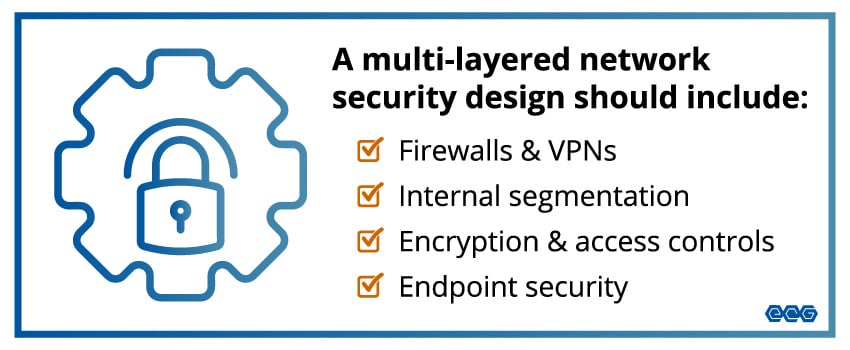
No single security solution is foolproof, and layering multiple network security measures ensures better threat detection and mitigation. A layered approach to network security design should include:
- Firewalls and VPNs to control access from external threats.
- Internal segmentation to isolate critical systems and make it harder for attackers to gain a foothold and move to new network segments.
- Encryption and cryptographically strong access controls to keep data protected.
- Endpoint security to safeguard devices connected to the network. The strongest networks are often vulnerable to malware running on Android phones or PCs, so detecting compromised endpoints or unusual activity is critical.
This defensive strategy creates redundancies that prevent attackers from easily compromising your critical systems if they manage to bypass a single security control.
2. Monitor and Respond to Threats in Real Time
Security threats are constantly evolving, making proactive monitoring integral for early detection and response. Consider implementing tools like security information and event management (SIEM) to aggregate and analyze logs and automated incident response systems to react to threats quickly. A SIEM might, for example, receive logs from your packet core, your IMS core, or other application servers; then it would use those logs to detect unusual activity.
These real-time monitoring solutions can help your network security teams detect and mitigate attacks promptly, often preventing significant damage or data loss when incidents occur.
3. Enforce Strong Identity and Access Management (IAM)
Identity and access management policies help businesses keep their most sensitive systems secure by ensuring that only authorized users have access. Strong IAM policies include:
- Multi-factor authentication (MFA) to reduce the risk of credential-based attacks.
- Role-based access control (RBAC) to limit user permissions based on job roles.
- Continuous user activity monitoring to detect unusual access patterns.
- Privileged access management (PAM) to provide extra protection for administrator accounts.
- Just-in-time access to grant elevated permissions only when needed.
Integrating IAM solutions into secure network architecture is vital not only for reducing unauthorized access risks but also for complying with regulatory requirements.
4. Regularly Update and Patch Systems
Around 32% of attacks in 2024 started with an unpatched vulnerability,3 making them one of the most common attack vectors for cybercriminals. Make sure to apply security updates as soon as they are available and automate patching where possible to minimize human error. You should also consider performing vulnerability scans regularly to identify any outdated software.
In critical systems with a high downtime cost, security updates need to be tested in a lab or in a limited deployment. You can deploy patches quickly to the evaluation environment, but be sure to confirm that all the systems are running well after those patches are applied.
This process is called regression testing because it detects when a system's behavior regresses. The 2024 CrowdStrike outage occurred because security vulnerabilities were patched automatically in a widespread way without the necessary regression testing to confirm that they were working properly.
5. Conduct Regular Security Assessments
Routine security assessments help organizations anticipate evolving threats. Some recommended practices include:
- Red teaming and penetration testing to simulate a real-world attack. This requires intelligent agents – usually humans – to attempt to find vulnerabilities. It can range from simplistic scans of open ports using a tool like Shodan to advanced persistent threat (APT) organizations. A separate team within the organization typically performs this where cybersecurity is most critical.
- Risk assessments to evaluate your overall security posture. These are best done from a "prosecutorial" mindset because they call on the assessor to find potential weaknesses rather than simply defend why the system is the way it is.
- Compliance audits to ensure all regulatory and contractual requirements are met. Many organizations sign cybersecurity commitments without realizing the costs of enforcing those.
- Gap analysis to compare current security methods against industry benchmarks.
These ongoing evaluation processes provide insights to update your network security architecture proactively, improving resilience against new threats before they cause harm.
6. Automate Security Tasks
Automate security patching and vulnerability scanning to the greatest extent possible. This makes the processes efficient and increases the likelihood that they’ll be performed consistently.
Security Architecture Example: Zero Trust In Telecom Networks
To showcase how these concepts might be applied in practice, let's consider a hypothetical scenario. A voice service provider that processes sensitive customer data – regulated Customer Proprietary Network Information (CPNI), customer network access logs, and calling records – might consider implementing secure network architecture like ZTA to enforce:
- Strict user verification through biometric authentication and MFA. Linux servers and application servers can be set up with single sign-on (SSO) via SAML to use Duo authentication before admitting login.
- Micro-segmentation to isolate financial transaction systems from general IT/email/Teams network traffic. The systems used to connect to IBOS, SWIFT, and VISA can also be isolated from one another so that an attack on one platform has no access to the others.
- Threat detection that monitors and flags suspicious activities in real-time. Syslogs and Network Function (such as CSCF, SBC, or Application Server) Logs can be streamed to an ELK Stack, with rules set to report on unusual events.
- Continuous security validation throughout every user session. Remote access can be strictly limited to SSH and TLS methods, which have continuous integrity verification.
This example demonstrates how a network security architect might design systems that minimize risk while maintaining regulatory compliance in a high-security environment.
Common Challenges in Network Security Architecture & How to Overcome Them
1. Tool Sprawl & Convergence
As networks grow, teams end up with multiple firewalls, CASBs, VPNs, EDRs, cloud-native tools, and monitoring platforms. Too many consoles mean gaps in visibility and inconsistent policies.
How to fix it: consolidate where it matters most (policy, decryption, telemetry). Moving toward SASE/SSE components or a unified policy engine helps you apply the same rules to branches, remote users, and cloud apps.
2. Security vs. Agility
Security teams want stability; DevOps and networking teams want speed. Manual firewall change tickets slow everything down.
How to fix it: favor software-defined controls, infrastructure as code, and CI/CD-driven policy updates. If security policies are expressed as code and versioned, you can approve faster without losing governance.
3. Legacy Systems
Old OT gear, unsupported appliances, or apps that can’t do TLS 1.3 still exist in most environments. They become permanent exceptions.
How to fix it: segment them aggressively, put them behind proxies, and apply compensating controls (WAF, IPS, allowlists). Assign an explicit risk owner and a retirement or modernization timeline so they don’t live forever in “temporary” status.
4. Hybrid and Multi-Cloud Consistency
Different clouds, different native controls. Over time, each environment drifts.
How to fix it: centralize identity (IdP), standardize policy expression (for example via a unified access broker or SD-WAN/SASE), and send all logs to a common SIEM/observability layer. Avoid custom rules per cloud unless there’s a hard requirement.
5. BYOD and Endpoint Diversity
Unmanaged devices are great for user productivity but terrible for assurance.
How to fix it: use device posture checks, MDM/EMM where users accept it, and least-privilege access tied to identity + device state. Combine ZTNA with conditional access so risky devices get reduced access, not full tunnel VPN.
6. Microservices and API Security
Modern apps talk to each other inside the network, so a perimeter-only model fails.
How to fix it: protect east-west traffic with service identity, mTLS, and a service mesh or API gateway. Enforce authN/authZ at the service level, not just at the edge. Log and rate-limit API calls to detect abuse.
7. Staying Ahead of Evolving Threats
Architectures age fast if detections don’t.
How to fix it: plug in current threat intel, run regular purple-team/pen tests against your actual controls, and review detections whenever you change architecture (new cloud, new WAN, new VPN). Treat detection content as a living asset, not a one-off project.
ECG: Network Security Design for Voice & Broadband Services
At ECG, we help service providers and enterprises build and maintain secure network architecture. Our engineering experts can work alongside your teams to design network security architecture solutions that protect against modern cyber threats while ensuring compliance with industry standards.
Whether you need guidance on network security design, securing remote access, or optimizing existing defenses, we’re here to provide insights and support tailored to your business needs.
Looking to strengthen your enterprise network security architecture? Contact ECG today to explore customized security solutions that align with your goals.
Network Security Architecture FAQs
Sources: